

Revolution Team
March 26, 2025
8 min read
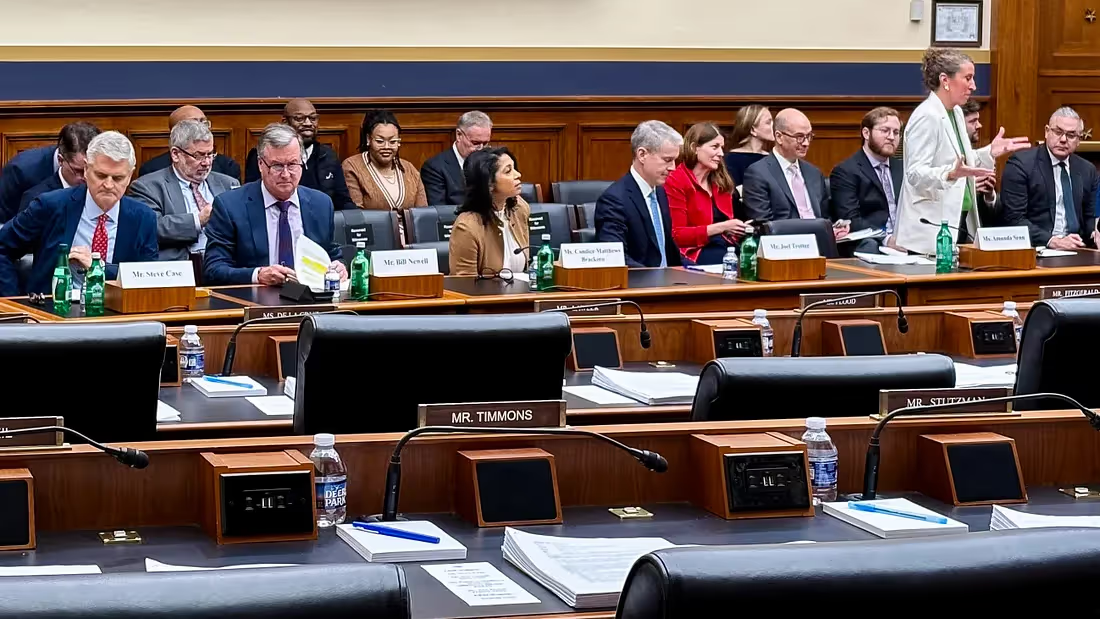
On March 25, 2025, Revolution’s Chairman and CEO, Steve Case, testified before the Committee during a session examining policy proposals to improve capital access. Watch the hearing and read his full testimony here and below.
For decades, despite party differences, legislation to encourage entrepreneurship and expand access to capital for entrepreneurs has largely received bipartisan support. I’ve been grateful to see that support firsthand throughout my career — whether through the passage of the JOBS Act, the creation of Opportunity Zones, or, most recently, the Regional Technology and Innovation Hubs (Tech Hubs) initiative. Each of these represents a significant governmental effort to strengthen American competitiveness by affirming the idea that cities can be renewed and rise again if they develop a vibrant startup culture. Today’s hearing underscores this committee’s commitment to prioritizing entrepreneurship and innovation, and I thank you for your leadership in making this a shared national effort.
Four decades ago, I co-founded America Online (AOL), a company that helped usher in the Internet revolution. AOL was the first internet company to go public and, at its peak, nearly half of all internet users in the U.S. were on the platform. Post-AOL, I dedicated myself to backing and supporting the next generation of entrepreneurs as Founder, Chairman, and CEO of Revolution. Based in Washington, D.C., Revolution’s mission is to build disruptive, innovative companies that upend age-old industries, with a unique focus on startups based outside of the coastal tech hubs. Companies in our portfolio are tackling supply chain and logistic challenges, making healthy food options more widely available, innovating in the retail and consumer space, disrupting the healthcare system, leading the way in digital sports and entertainment, and more. We believe great companies can start and scale anywhere, aided by the fact that startups in emerging venture communities are often more capital efficient, offer a lower cost of doing business, and attract talent looking for a better quality of life.
This discussion is especially meaningful as our country approaches its semi-quincentennial next July. I often say that America was once a startup — and a fragile one at that. Our nation became the global economic leader it is today because of the countless entrepreneurs who had transformative ideas and found fertile ground — fertile, in part, because of policymakers who cultivated an environment for innovation — to bring them to life.
Startups are the lifeblood of our economy, driving innovation, creating jobs, and fueling growth in red and blue communities nationwide. Indeed, new businesses play a significant role in net new job creation in the U.S., according to data from the National Bureau of Economic Research. Yet entrepreneurs — especially those outside Silicon Valley, Boston, or New York — still face significant challenges in accessing the capital needed to scale. That’s why the reforms we’re discussing today are so important. They have the potential to ensure that great ideas aren’t left behind but instead can take root and grow in communities across the country — not just in traditional tech hubs.
When I started AOL, not far from here in the fields of Northern Virginia, most of our venture dollars came from investors in Silicon Valley and New York. Our lawyers were from Boston because Washington, D.C. — the city with the most lawyers per capita in the country — did not yet have attorneys with tech startup experience. D.C. has since come a long way, and so have other cities, but they have not come far enough to fully compete with the concentration of capital, talent, and celebrated risk-taking found in Silicon Valley.
At the same time, industries that once powered cities in the middle of the country have suffered, leading to an outflow of potential founders and tech employees and creating what I call the “possibility gap.” In tech hubs, people view progress as an upward trajectory — there is a sense of infinite possibility. In many other cities across the U.S., the picture is much more complicated, and parents often worry about whether continued livelihoods exist for their families in their hometowns.
This is not to say that these cities have opted out. On the contrary, for the last decade, I have been getting out of my office and onto a bus to see what’s going on in startup ecosystems across the country. Revolution’s Rise of the Rest initiative has visited dozens upon dozens of startup ecosystems across the country and backed more than 200 seed-stage companies in more than 100 cities. We’ve made these investments because we are constantly impressed by the remarkable talent and groundbreaking innovations emerging in these communities — where fresh ideas intersect with deep, legacy expertise.
Take Detroit, for example. It was the Silicon Valley of its day, churning out the country’s most transformative technology: the automobile. When our team first visited its startup community in 2014, the city had just declared bankruptcy, and people were not betting on an innovation-driven future. Fast forward to today and Detroit recently celebrated the opening of Michigan Central, a massive tech campus focused on mobility and centered around a once-abandoned grand train station restored by a billion-dollar investment from Ford.
I can share similar stories from nearly every city in the country. In Atlanta, Hermeus is building military aircraft engines with the potential to reach hypersonic speeds as fast as Mach 5. They have benefited from the presence of Georgia Tech and its graduates nearby. In Chicago, Tempus is leading the way in the application of AI in healthcare. AcreTrader, founded in Fayetteville by an Arkansan who boomeranged home after a stint working for a Bay Area hedge fund, is reshaping the market for farmland by offering critical data on land and facilitating investments. Finally, Anduril, a company we backed in its infancy, just announced that it is opening a new facility in Ohio with 4,000 new jobs to start. These are great stories. I have more like them, but not nearly enough.
In 2017, when Revolution launched our Rise of the Rest Seed Fund, led at the time by J.D. Vance, who is now our Vice President, roughly 75% of venture capital flowed to just three states: California, Massachusetts, and New York, with 47 states left to share the remaining 25%. We’ve made some progress, but unfortunately, the split remains largely the same today.
The federal government can help close this gap, and there is strong precedent for them to do so. In 2011, I was part of the President’s Council on Jobs and Competitiveness with several other leaders in finance and tech. Our proposals eventually became the bipartisan Jumpstart Our Business Startups (JOBS) Act, which passed the House by a vote of 390–23. The JOBS Act included three key goals: first, make it easier to launch and invest in start-ups via crowdfunding; second, venture firms and those seeking investment should be able to make general solicitation appeals via mass media; and third, create an IPO-on ramp to make going public easier with less onerous disclosures. In the wake of the JOBS Act, IPOs increased and, while crowdfunding proved viable, the SEC focused more on potential risks than opportunities and the robust provisions we recommended never fully came to fruition.
Given the outsized role startups play in job creation and economic growth, and the early success of the JOBS Act, there remains much we can do to expand access to capital while enhancing the ability of everyday investors to participate in private markets. This notion is reflected in many of the reforms put forth by members of this committee today.
First, while late-stage markets have had ample capital in recent years, the strength of these markets has limited the number of companies going public. However, that funding option is not guaranteed, and having a viable path for IPOs remains critical.
Additionally, Revolution — partnering with PitchBook — found that between 2011 and 2021, more than 1,400 new venture firms emerged from smaller ecosystems across the country. These firms are crucial because they are more likely to invest most of their dollars in local and regional startups. Investor incentives, expanding investment opportunities and the pool of individuals who can invest in those new funds, as well as reducing their compliance costs can help sustain these funds — especially in today’s challenging venture capital environment. To be clear, none of the reforms proposed should come at the expense of investor protection, but at the same time, we need to make sure our laws reflect the way technology and innovation has grown in this country and rival nations. The world is changing, and our securities laws must change with it.
Finally, I want to make a broader point about America’s ability to compete globally — particularly with China. Continuing to win this competition and thereby protecting our national and economic security requires a multi-pronged approach. Aside from increasing access to capital for entrepreneurs, we must continue to invest in basic R&D, especially in our universities and national labs, most of which are in the middle of the country. They will play a key role in building the innovations of the future, and if we do this right, they can also serve as anchors for a new generation of tech hubs. You have already recognized the national security importance of developing tech hubs, which is why last year’s National Defense Authorization Act included $500 million for tech hub initiative grants, and that bill was passed by wide margins in both chambers. There is a real risk that funding for these schools and critical research centers could continue to face cuts, which would undermine our innovation leadership and weaken our competitive edge in many sectors, including healthcare and biotech, AI and quantum computing, and industries yet to be invented. Second, we must also continue to win the battle for talent. This means smarter immigration policies, like the proposed Heartland Visa — a program to encourage highly skilled immigrants to live and work in designated areas with slow growth — to ensure the world’s best and brightest can start and scale their businesses in America. Winning this global competition will require a national commitment to innovation that leaves no community behind. These ideas were formally put forth last year by NACIE (National Advisory Council on Innovation & Entrepreneurship), a group of extraordinary founders, investors, and academics focused on policy recommendations at the Commerce Department. I was fortunate to chair this group twice.
We all know that talent is everywhere, but opportunity is often not. Rise of the Rest is based on a simple premise: cities can be renewed and rise again if they develop a vibrant startup culture. But they can only fully develop that culture if they have the capital needed to scale. This Committee is in the unique position to pass legislation that will support capital access for entrepreneurs across the country. I applaud the efforts you are taking today to level the playing field and, as we approach our 250th anniversary, empower entrepreneurs nationwide to write the next chapter of the American story.
.svg)