


Revolution Team
May 14, 2024
Once overwhelmingly dominant, California’s share of climate tech funding has decreased significantly over the last five years as ecosystems across the country build momentum.
As climate tech becomes an increasingly active and well-funded sector, we wanted to know where innovation clusters were emerging and why. So, we turned to PitchBook to map the evolution of sustainable startup funding — and were encouraged by what we found.
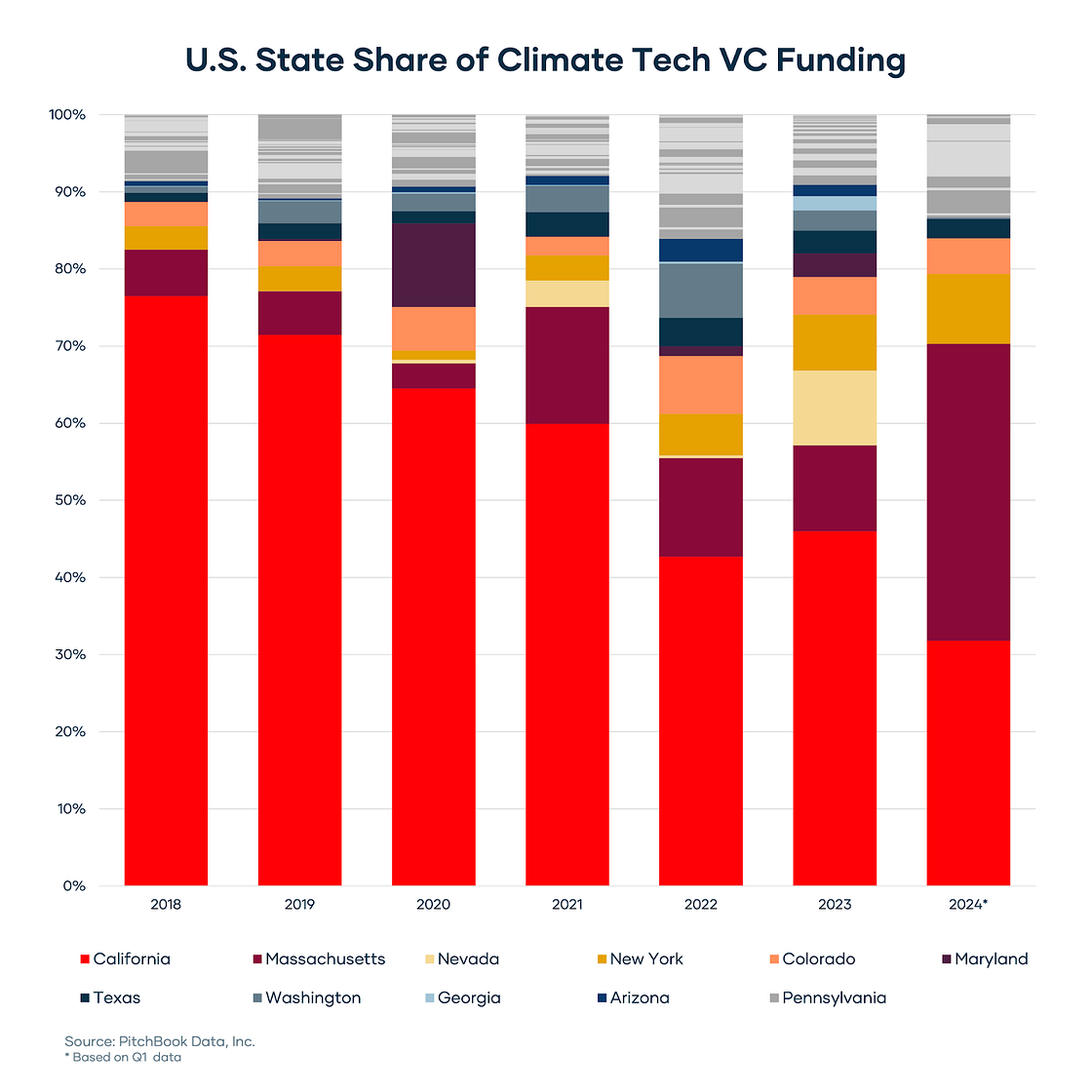
In the last half-decade, California’s grip on climate tech capital has waned significantly, with its share of funding falling from 76% in 2018 to less than 46% in 2023. Don’t get us wrong — 46% is still a disproportionately large piece of the pie to go to a singular state. But a 30%+ decrease is notable, and means a larger share of VC dollars are being funneled into ecosystems beyond the Golden State.
One of our fundamental theses at Revolution is that America is more competitive when more people in more places are part of the innovation ecosystem. Accordingly, a more dispersed climate tech economy will lead to greater innovation and more ready adoption of climate solutions. Why? First, different regions have different legacy industries, talent pools, corporate players, challenges and opportunities. That diversity in thought, resources, and experience is a catalyst for new climate solutions when capital is distributed rather than concentrated. Second, as climate tech startups start, scale, and create jobs in their regions, more people across the country will be part of building the sustainable solutions of tomorrow, which inevitably leads to greater buy-in.
So where exactly are these climate tech hubs springing up? Across the country, according to PitchBook funding data — from the Southeast to the Pacific Northwest, and everywhere in between.
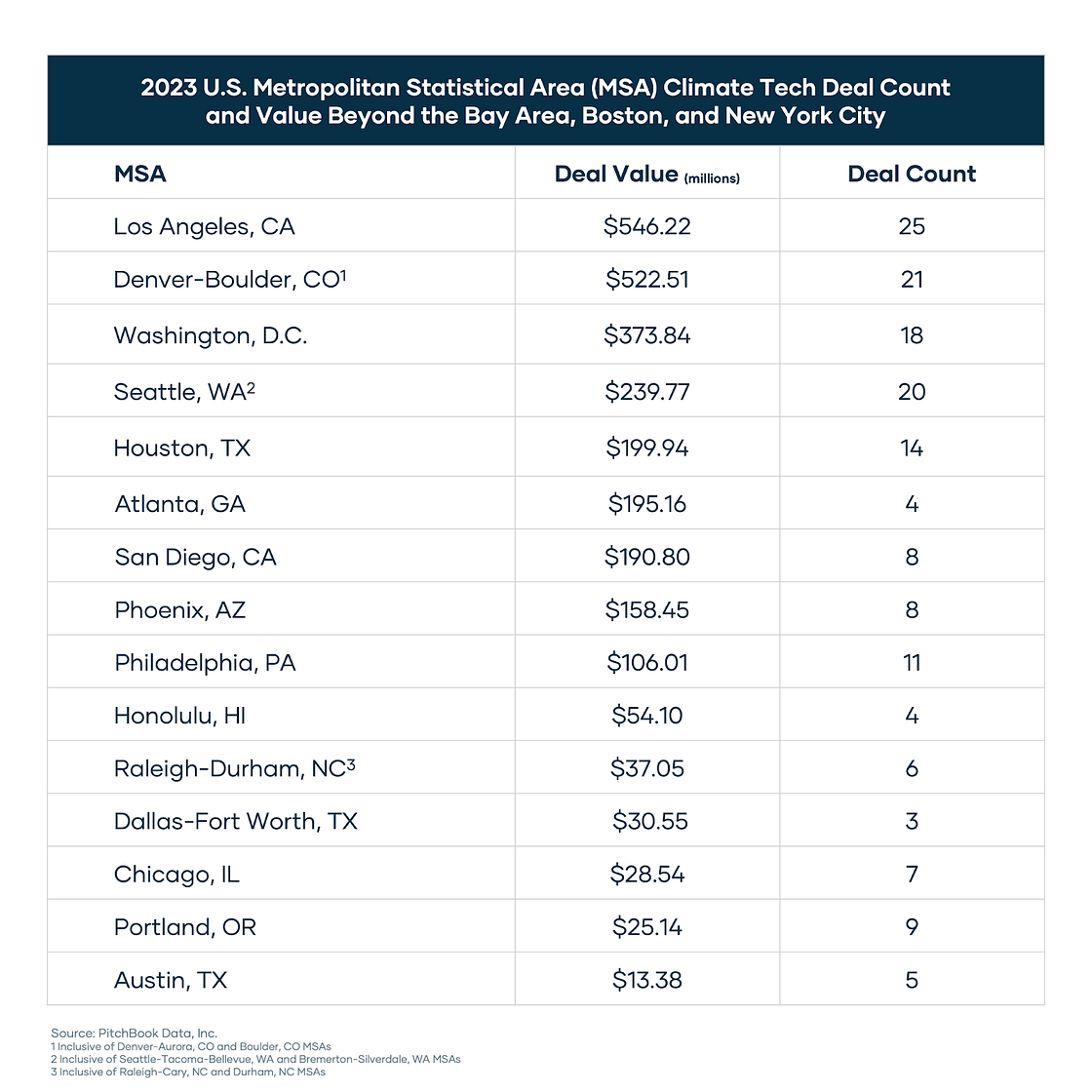
While traditional coastal tech hubs still hold considerable influence, dozens of climate tech clusters are emerging between them. The chart above shows 15 MSAs to watch beyond Silicon Valley, New York City, and Boston based on total funding and deal count in 2023. Below, we dive into four that have built substantial momentum in the last five years and the factors that have contributed to their evolution.
Denver-Boulder: Colorado’s capital city (and surrounding ecosystem) has a legacy of aerospace and bioscience innovation, with an outdoor recreation culture that’s attracted a population of environmentally-minded tech talent.
- Tailwinds: Proximity to leading research institutions, such as the National Renewable Energy Laboratory, has fostered innovation in clean energy technology development. The ecosystem’s diverse climate and geography also make it an ideal testing ground for renewable energy solutions, including solar and wind power.
- Startups to Watch: Crusoe, the climate-aligned digital infrastructure company tapping into wasted, stranded, and clean energy; GoodBuy Gear, the recommerce marketplace for open-box and secondhand baby and kids gear; and Meati, the sustainable, whole-cut protein company with products made from 95% mushroom root.
Washington, D.C.: Shaped by its proximity to policymakers and federal agencies, D.C.’s startup ecosystem is a uniquely advantageous environment for entrepreneurs scaling startups in regulated industries.
- Tailwinds: D.C. sits at the intersection of policy and tech, offering a favorable environment for climate tech startups seeking government contracts and looking to influence policy agendas.
- Startups to Watch: Arcadia, the global utility data and community solar company; Cambium Carbon, the startup scaling a regenerative lumber supply chain; and Optoro, the reverse logistics platform helping retailers keep returned goods in circulation.
Seattle: Home to major corporate players and research institutions, Seattle has proven to be fertile ground for entrepreneurs scaling startups in AI, big data, and life sciences.
- Tailwinds: Seattle’s robust talent pool, fueled by Amazon and Microsoft, has been a boon for the city’s climate tech ecosystem. Institutions like the University of Washington and Pacific Northwest National Laboratory also foster continuous research, innovation, and advances in climate tech’s practical applications.
- Startups to Watch: Carbon Robotics, a leader in AI-powered robotics to support agriculture and regenerative farming; and Mast Reforestation, the company facilitating faster, more resilient forest regeneration through vertically integrated services.
Houston: Houston has strong ties to a few major industries, including aerospace, energy, and healthcare, creating a climate of cross-sector innovation and diverse entrepreneurial talent.
- Tailwinds: With its deep-rooted energy sector, Houston is an attractive HQ for companies innovating within renewable energy, carbon capture, and emissions reduction. Partnerships with oil and gas companies also provide unique collaboration opportunities for climate tech startups, accelerating market adoption and helping companies achieve scale quickly.
- Startups to Watch: Buildforce, the marketplace and career lifecycle platform for electrical trade workers; Fervo Energy, the company supplying carbon-free energy through the development of next-generation geothermal projects; and Solugen, the startup developing sustainable, bio-based chemicals to replace traditional petroleum-based products.
Beyond these four ecosystems, there are dozens more becoming climate tech players — a trend we believe will continue as urgency grows and federal industrial policies and climate initiatives come to bear. For more on the evolving geography of climate tech funding, download Startup Seedbeds: America’s Top Climate Tech Hubs.
.svg)