

Revolution Team
October 14, 2025
5min read
For the third event in our Beyond Silicon Valley Speaker Series, we gathered at STATION DC for a conversation on one of the most consequential, fast-evolving, and increasingly funded frontiers: defense tech.
Hosted in partnership with J.P. Morgan and STATION DC, the gathering brought together founders, investors, and policy influencers shaping how new technologies are built, scaled, and adopted across the defense ecosystem.
Why D.C. is the Epicenter
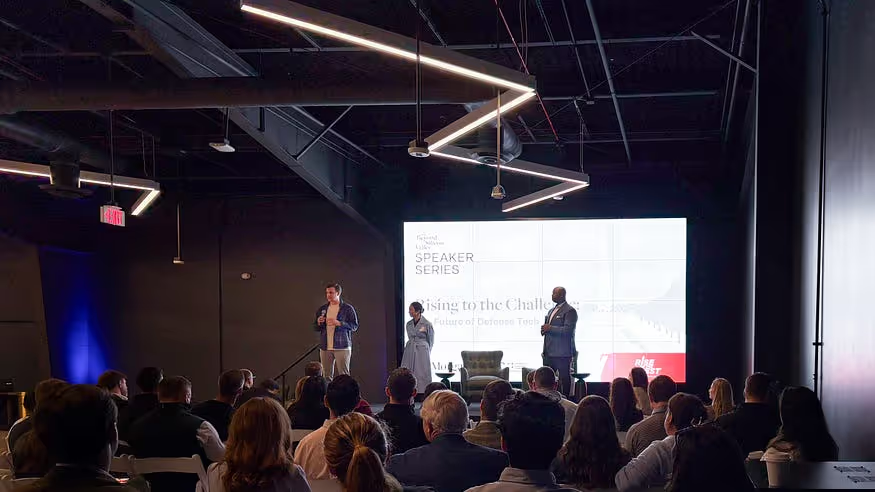
In tech and investing, place matters. And few places are better positioned than D.C. to lead the next wave of defense innovation.
“This was the first and only place we thought about hosting,” said Rise of the Rest’s David Hall about STATION DC, who noted the growing concentration of founders and operators across the region all having a new hub to convene. “The density of talent, policy expertise, and purpose starting to assemble here is incredible.”
J.P. Morgan’s Vivienne Pham echoed the sentiment, sharing the importance of starting relationships with founders early and helping raise the profile of emerging defense tech companies in the region. As she put it, “Our job isn’t just financing startups; it’s bringing ideas, introductions, and opportunities to the table.”
Where Policy Meets the Frontier

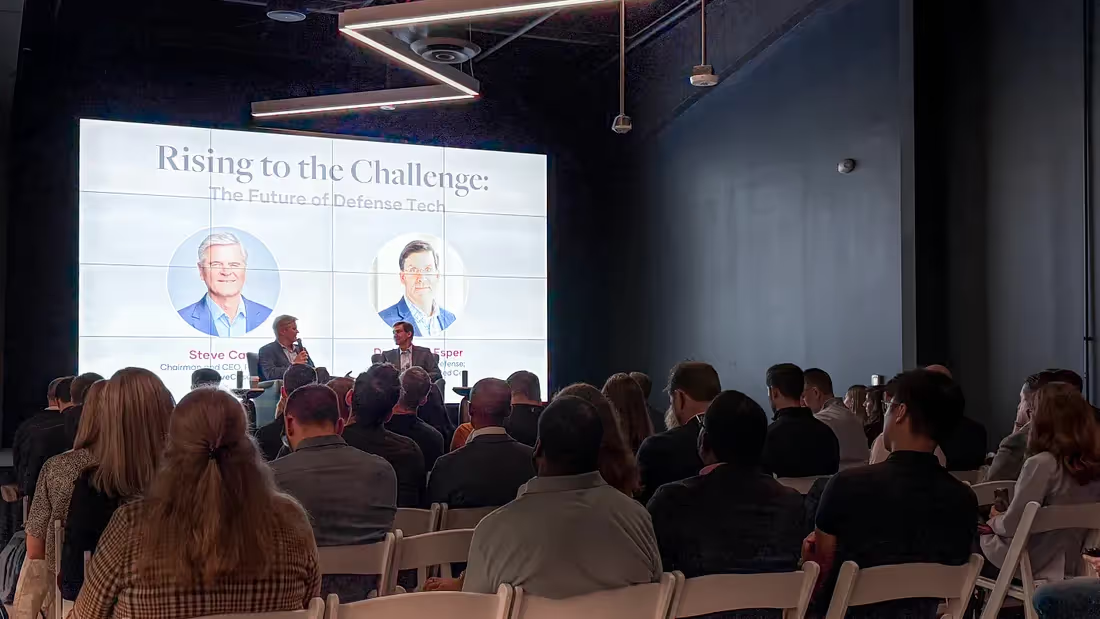
The opening conversation between Steve Case and former Secretary of Defense and Red Cell Partner Mark Esper centered on a theme with deep D.C. roots: a growing wave of policy-adjacent industry transformation.
“The government doesn’t have an innovation problem. It has an adoption problem.”
Esper noted that the challenge is no longer a shortage of technology but integrating it into systems at scale. He also pointed to recurring revenue, not research grants, as the true marker of progress for defense startups. “That’s the golden ticket. It shows you’ve moved from prototype to platform.”
On artificial intelligence and autonomy, Esper described the defining technologies of modern warfare: “If you can take people out of harm’s way, you should. Autonomous systems won’t be perfect, but they’ll be better than manned ones.”
Esper also reflected on the global race to lead in emerging technologies. “The most pivotal invention of our time is AI, and whoever masters it will set the standards and ethics for the world. We want that to be the United States, not China.”
While the U.S. continues to lead in invention, he warned that China often outpaces in application. Closing that gap will depend on faster adoption, a stronger industrial base, and deeper public-private collaboration.
“It’s not startup versus prime. It’s startup and prime. One brings innovation, the other brings manufacturing might and experience. It can be a win-win-win for startups, primes, and the warfighter.”
Washington Business Journal reporter Nate Doughty shares more on their conversation.
Building and Backing the Next Generation
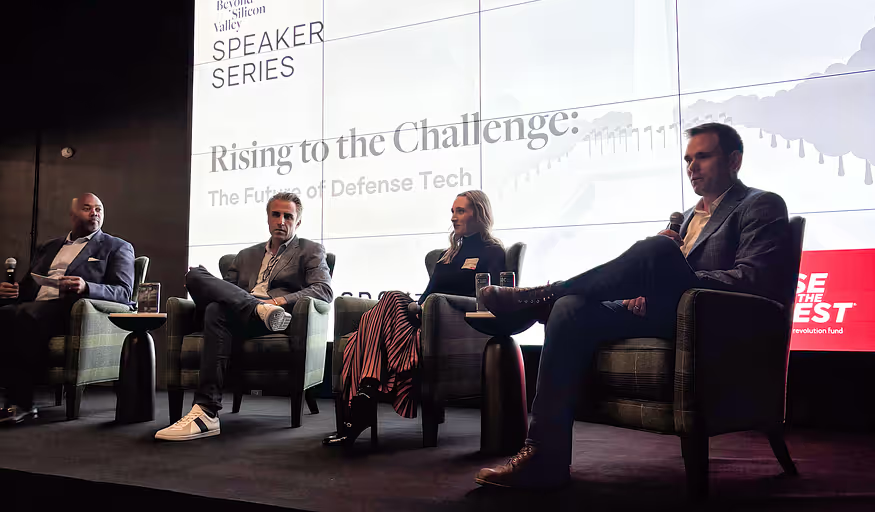
Following the fireside, David Hall moderated a discussion between Tara Murphy Dougherty, CEO of Govini, Guy Filippelli, Managing Partner at Squadra Ventures, and Josh Araujo, CEO of Forterra, on what it takes to found and fund startups navigating a high-stakes, complex sector dominated by a shortlist of incumbents.
On the realities of dual-use models, the panelists emphasized discipline and patience.
“Commercial customers always write checks faster,” said Murphy Dougherty. “Many startups go dual-use too early and lose focus. You have to earn product-market fit every day. It’s like staying in shape.”
“Commercial pilots that align with DoD roadmaps can be incredibly valuable,” said Araujo. “Commercial feedback loops are faster. The government gives you scale.”
“You can build a hundred-million-dollar company selling only to defense,” said Filippelli. “The obsession with dual-use is often optics, not strategy.”
The Long Game of Partnership
When it comes to partnering with primes, the panel agreed that collaboration takes time, trust, and alignment.
“Primes aren’t designed for subs to win, but they’re not the enemy either,” said Murphy Dougherty. “They’re integrating what the future fight needs.”
“Partnerships take years to mature,” said Araujo. “Our three-year collaboration with BAE shows that clear mission alignment and candor about capabilities matter.”
“Primes are collections of people,” said Filippelli. “The trick is motivating the individual champion within them.”
As for long-term strategy, Murphy Dougherty pointed to the need for scale and ambition. “I don’t want to navigate around the big fish. I want to be the big fish. Palantir shouldn’t be the anomaly.”
The panelists also discussed the shifting valuation landscape for defense tech.
“Primes still buy at one to two times revenue,” said Filippelli. “We want companies that can sell at twenty times. Some public comps today are already trading at sixteen or seventeen. That’s encouraging.”
America’s Edge
The conversation turned to the foundations of U.S. strength: industrial capacity, operational efficiency, and the startup engine driving defense innovation.
“If the first time you touch a system is in combat, it’s too late,” said Araujo. “We need faster testing, iteration, and field feedback.”
Murphy Dougherty pointed to manufacturing as America’s weakest link: “We have the edge in AI, but China crushes us in production. Without rebuilding our industrial base, we’ll squander that advantage.”
Filippelli noted that the U.S. still holds an unmatched asymmetry: “We see fifteen new defense decks a week. No other country has that innovation density.”
The panel agreed that modernization must extend beyond weapons systems. “Every warfighting enabler deserves modern software,” said Murphy Dougherty. As Araujo added, “The faster something is in use, the faster you uncover edge cases and get real-world feedback.”
Closing the discussion, Filippelli offered a reminder that progress in defense tech takes both urgency and endurance: “Be in a rush, but be tactically patient.”
Speed matters, but relationships, trust, and persistence are what ultimately get new technologies deployed when it counts. And much of the sprint and marathon are happening in D.C.
.svg)