
Mahati Sridhar

Revolution Team
July 28, 2025
7 min read
Inside the startup–utility partnership that’s testing how we can make existing buildings cleaner, smarter, and ready for a lower-carbon future.
In tech and infrastructure, it’s easy to focus on what’s next: futuristic buildings, next-gen grids, communities built from scratch. But so much of the real challenge and opportunity lies in bringing what’s already here up to speed.
That’s where Carbon Reform comes in. They’re tackling one of the biggest blind spots in building decarbonization: how to make existing commercial buildings cleaner, healthier, and more efficient, without tearing them apart in the process.
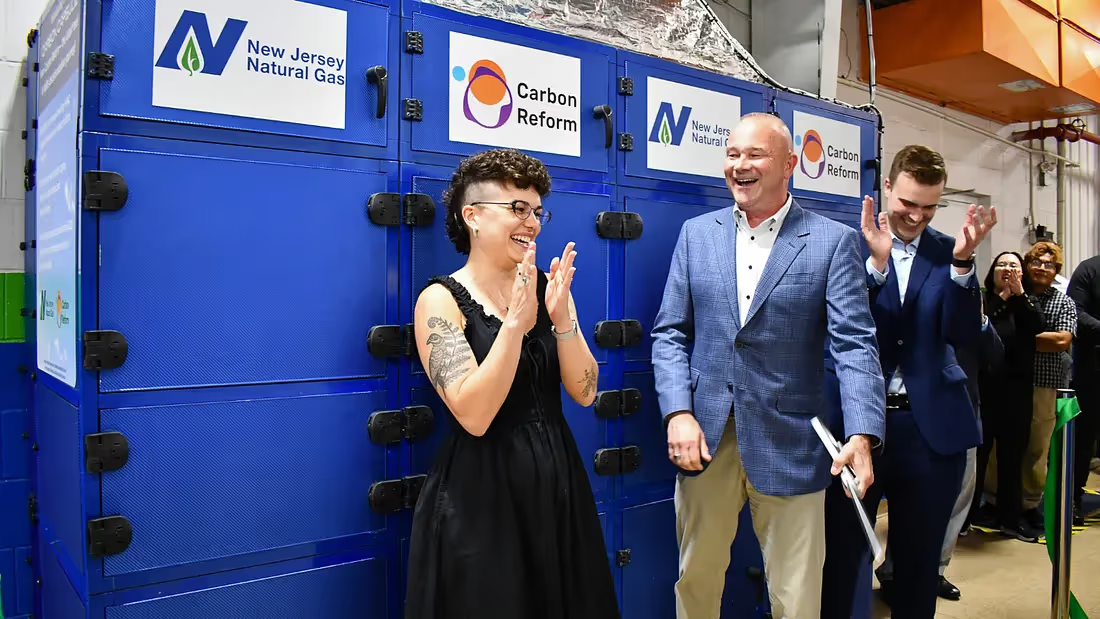
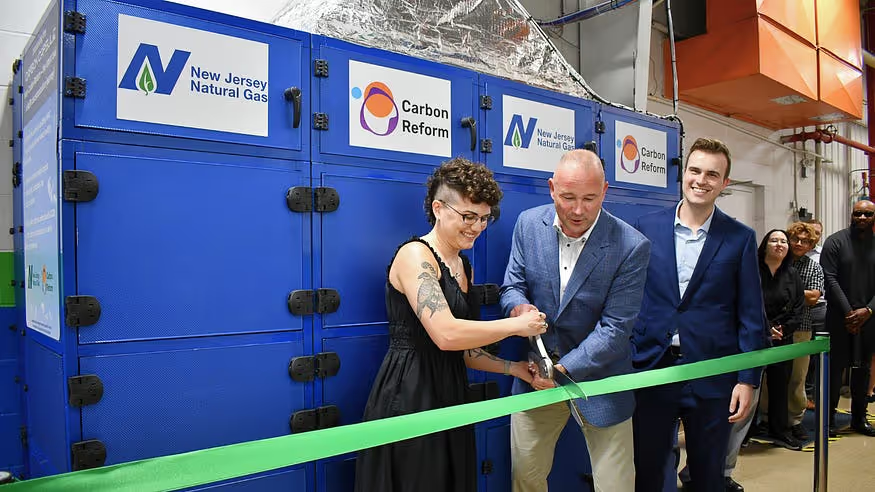
This week, Carbon Reform launched a new project with New Jersey Natural Gas, marking the first utility deployment of their Carbon Reduction System in New Jersey. I sat down with co-founder and CEO Jo Norris to discuss why retrofits are climate tech’s unsung hero, how startups and utilities can move faster together, and how their modular system is built for the complex realities of the built environment.
You’ve built a climate tech company focused on retrofits, not new construction. Why do you think the commercial building sector has been overlooked — and what makes it such a big opportunity?
There’s certainly a market for new construction, but here’s the reality: 80% of the buildings that will exist in 2050 are already built. The industry loves new construction because it’s exciting and visible, but retrofitting is where we can actually accelerate progress on climate goals while working smarter with existing infrastructure. Plus, retrofitting lets you work creatively within real-world constraints around budget, time, and space.
The energy conservation measures available until now have been pretty straightforward — new lighting, energy-efficient appliances, maybe solar panels — but they haven’t been comprehensive enough to hit our decarbonization targets. Building owners naturally focus on immediate operational benefits, which is exactly why our approach works so well. We’re delivering carbon reductions right now, not waiting decades for new buildings to get constructed or overhauling buildings and adding to the carbon problem. Retrofitting, specifically with our tech, is economically attractive rather than just another expense. That fundamentally changes how building owners should think about climate solutions.
This collaboration with NJNG is a first for both sides. What does it tell us about how climate startups and legacy players can work together to accelerate decarbonization?
This NJNG installation is exciting for us because it’s the debut of our Carbon Capsule V3, which is our lowest energy model yet, and it’s the first Carbon Reduction System deployment in New Jersey. What makes this collaboration work is that NJNG brings established customer relationships and market credibility, while we bring the technology they need to demonstrate truly innovative energy efficiency measures. When a utility that serves half a million customers validates your technology by installing it in their own facility, it creates trust with potential customers. NJNG advances its sustainability goals and sets itself up as a leader in decarbonization, and we get fast market penetration with proven technology. It’s a model that leverages each partner’s strengths to actually accelerate climate impact.
The new Carbon Reduction System does a lot: carbon capture, air purification, and energy savings. What design principles helped you deliver that kind of multifunctionality in a modular system?
The Carbon Reduction System brings together all the technologies buildings need to hit the triple bottom line of people, planet, and profit. Our proprietary Carbon Capsule technology provides permanent CO2 capture while delivering superior air purification benefits. We built hardware, controls, and sensors that intelligently optimize energy usage for the existing HVAC system. Each piece matters on its own, but when they work together in one system, building owners get comprehensive value without having to juggle competing priorities.
The modular design came from years of customer feedback and real field data showing us that every building has different constraints and requirements. We’ve made the system completely customizable — NJNG even chose to make their Carbon Capsule blue to match their branding! The modular hardware lets us tailor everything to specific building specs, whether that’s space constraints, capacity needs, or aesthetic preferences. You can scale up or down and upgrade individual components without replacing the entire system, which future-proofs the investment.
Above all, we designed our technology to be a practical and efficient way for building operators to achieve their goals. That’s what makes the system actually deployable at scale rather than just impressive in a lab.
.avif)
Most buildings that stand today weren’t designed with sustainability in mind. How are you navigating the realities of retrofitting in the field, and what’s surprised you in the process?
Most buildings standing today were designed to prioritize square footage over efficiency or air quality. Now, we’re retrofitting buildings that have space constraints, HVAC systems that vary wildly in age and design, and legacy infrastructure that wasn’t built to support modern technology. That’s why we built our system to be modular and work with existing HVAC rather than requiring major overhauls. The whole design philosophy is about adapting to what’s already there instead of forcing buildings to adapt to us.
What’s really surprised me is how willing building operators are to try new technology once they see the business case, but also how different their priorities are. Some companies are laser-focused on the air quality piece because they have people-forward priorities, others are super interested in the permanent carbon capture and using the limestone byproduct to showcase their closed-loop commitment, and others just want the energy cost savings or help with emissions compliance. We built one system, but we’re solving different problems for different customers.
On the operational side, we’ve learned to integrate not only the physical systems, such as HVAC and BMS, but also existing processes—working with preferred contractors and collaborating with facilities teams that handle maintenance and installations. Instead of creating new operational burdens, we plug into workflows that building operators already have in place.
From where you sit, what does real traction look like beyond this partnership? What’s next for scaling the impact of Carbon Reform’s technology?
Real traction for us looks like moving from these initial partnerships to commercial deployments at scale, and we’re seeing that momentum build. We have a proven energy savings model and excellent results from our existing installations, which are creating demand for broader market adoption. We’ve built a pipeline across different building types and are focused heavily on Philadelphia, New Jersey, and the broader Mid-Atlantic region, where building emissions regulations are strict and the need for our technology is very much there. The ESCO (Energy Service Company) relationships have been huge for us because they can integrate carbon capture into their existing efficiency offerings, creating new pathways to market.
What’s next is really about scaling in every direction. We’re leveraging the NJNG installation to set an example for other utilities across different states, and we’re targeting commercial building sectors like offices, schools, retail, and healthcare, where we’ve already seen interest and understand their specific pain points. This is a really big year for us in terms of building out manufacturing capacity to meet demand. On the technology side, we’re focused on iterating, with a large emphasis on controls and what makes our system work optimally for each building to maximize its benefits. We’ve proven the technology works — now it’s about getting it deployed widely enough to make a real dent in commercial building emissions.
In today’s environment, how, if at all, are you leveraging local, state, or federal resources to support the growth of your business?
We designed our technology to deliver energy savings and air quality improvements that make economic sense across the political spectrum, so our business doesn’t hinge on any particular federal incentives or resources. What’s really exciting is seeing states, cities, and individual companies leading decarbonization efforts on their own timeline. Building emissions regulations like NYC’s Local Law 97 are creating real market demand, and states like New Jersey and Pennsylvania are setting renewable energy standards that indirectly support businesses like ours. The market demand is being driven by practical building needs and local policies, not just federal mandates.
What’s been essential for our growth is building relationships with local governments and utilities who are actively pursuing these goals. Our relationship with the City of Philadelphia has been valuable, and partnering with local utilities like NJNG and Baltimore Gas and Electric is a key part of our distribution strategy. These utilities are becoming essential bridges between our technology and commercial customers who want to meet their sustainability targets. This bottom-up movement from states, cities, and companies creates consistent regional demand regardless of what’s happening at the federal level.
.svg)